Why a Sudoku Given Has Fewer Possible Homes Than It Seems
Sudoku cell candidates shrink as row, column, and box rules overlap, helping you spot forced placements without guessing or solving the whole grid.
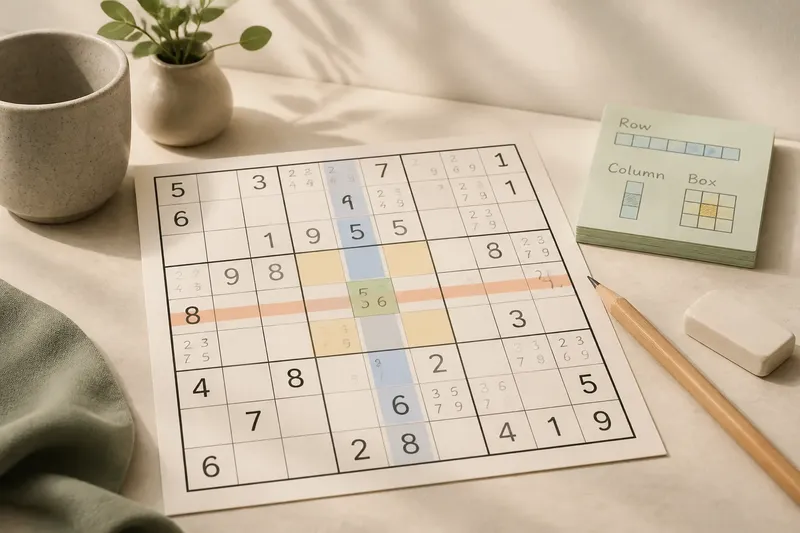
The common Sudoku mistake is to scan a blank cell, notice several numbers missing nearby, and treat each as equally plausible. That overlooks the other two constraints, so a solver may chase candidates that another part of the grid has already ruled out. Sudoku cell candidates are not determined by one line at a time: each blank must satisfy its row, its column, and its 3-by-3 box together.
What does a candidate mean?
A candidate is a digit that could legally occupy a particular blank, given the digits already placed in that cell’s row, column, and box. In a standard Sudoku, each of those three regions must contain the digits 1 through 9 without repeats. A digit is ruled out if it already appears in even one of the three regions.
For a blank cell, start with the full set of digits, 1 through 9. Remove every digit already present in its row, then remove those present in its column, and finally remove those in its box. The digits left are the cell’s candidates. A digit removed more than once still counts as just one eliminated possibility.
This is a local calculation: it says what can fit in this cell right now, not what will ultimately be correct. A candidate may later disappear when another cell is solved. Conversely, a digit that remains may still be impossible once the wider puzzle is considered. Keeping that distinction clear prevents a pencil mark from being mistaken for an answer.
How do the three constraints overlap?
Imagine a blank at the intersection of a row, a column, and a box. The row may already contain 1, 4, and 7; the column may contain 2, 4, and 8; and the box may contain 3, 7, and 9. Taken together, those regions rule out 1, 2, 3, 4, 7, 8, and 9. The remaining candidates are 5 and 6.
Notice that the example does not require each region to be nearly full. A few placed digits can combine to eliminate most of the possibilities, especially when they are spread across all three regions. The shared digits, such as 4 and 7 in this example, do not create extra eliminations; they simply show why adding the separate counts would be misleading.
The overlap can also be seen as three intersecting neighborhoods. The row and column cross at the cell, while the box contains part of both. A digit elsewhere in the box might also lie in the same row or column, so it can be visible to the cell through more than one route. The candidate set depends on the union of all forbidden digits, not on how many times each one is noticed.
Why can a missing digit still be impossible?
A digit can be absent from the row and still be excluded by the column or box. “The row is missing a 6” therefore does not mean every blank in that row can take a 6. Check the candidate list for each cell rather than assigning a missing digit by appearance.
The reverse distinction matters too: a digit can be a candidate for a cell even if it is not an obvious choice. If none of the three regions contains that digit, the local rules permit it there. That does not establish it as the solution; it only means the cell’s immediate constraints have not eliminated it.
One useful habit is to ask two separate questions: “Which digits are allowed in this cell?” and “Which allowed digit must go here?” The first is answered by the three-region check. The second needs additional information, such as discovering that the digit has no other available place in a region, or that the cell is the only one with that candidate.
How can a candidate point to a placement?
Sometimes the important fact is not that a cell has one candidate, but that a digit has only one available cell within a row, column, or box. Suppose you are considering 6 in a particular box. If every other blank in that box already sees a 6 in its row or column, the remaining cell must take 6, even if it has other candidates.
This is a hidden single: the digit is “hidden” among a cell’s other candidate marks, but it has only one location in its region. A naked single is the complementary case: one cell has only one candidate left. Both deductions come from the same constraints, but they ask different questions. For a naked single, count options for a cell; for a hidden single, track where a chosen digit can go within a region.
Say you are checking a box with three empty cells, and 5 remains possible in just one of them. The other two cells may each have several candidates, but if their row or column already contains 5, neither can take it. The one location left in the box must be 5. This invented example illustrates a deduction, not a full puzzle or a claim that every sparse box works the same way.
What should you write in the grid?
Candidate notes are useful when they stay readable and current. You can write small digits in the corners of blanks, use a separate candidate grid, or keep notes mentally in a simple region. Choose a method that makes it easy to erase a candidate when a new placement rules it out. Avoid filling every blank with tiny marks before you have looked for straightforward placements; the clutter can hide the useful relationships.
After placing a digit, update only the affected peers: blanks in its row, column, and box. Remove the placed digit from their candidate lists, then check whether any cell has become a single candidate or whether a region now has only one place for some digit. A placement cannot affect candidates beyond those three regions directly, although a new deduction may lead you to update other parts of the grid later.
Do not spend time making candidate notes look perfectly uniform or using a special notation system if it slows down the actual reasoning. A plain pencil and eraser are enough for many solvers. The point of notes is to expose a constraint, not to decorate every blank.
Where do solvers often misread the rules?
- Checking only the row: A missing row digit may be blocked by the cell’s column or box.
- Checking only the box: A box candidate can still conflict with the row or column crossing that cell.
- Counting repeated exclusions twice: A digit seen in both the row and box is one forbidden digit, not two separate candidates removed.
- Treating a candidate as a commitment: A pencil mark records a current possibility, not a promise that the digit belongs there.
- Updating only one region after a placement: Remove the digit from affected blanks in the row, column, and box, then look for consequences.
For a standard puzzle, the familiar 3-by-3 boxes and digits 1 through 9 define the regions and symbol set. Other Sudoku variants may change the board or add constraints, so follow the rules printed with that puzzle; the basic candidate method then uses every applicable rule, not just the standard three.
Which candidate questions come up most often?
Can a cell have no candidates?
In a correctly maintained standard grid, a blank with no candidates signals a contradiction or an earlier error. Recheck the row, column, box, and recent placements before continuing.
Can two cells share the same candidates?
Yes. Two blanks can have identical candidate sets and both remain valid possibilities at that point. Their shared options may support a later deduction, but the matching lists alone do not decide which digit belongs in either cell.
Should I guess when several candidates remain?
Not simply because a cell has multiple candidates. First check for a single candidate in another cell, a digit with only one location in a region, or a useful relationship among candidate marks; guessing can make an unnoticed error harder to trace.
Does a candidate list prove the puzzle has one solution?
No. It records local possibilities under the rules you have applied. Establishing whether a puzzle has a unique solution requires reasoning across the grid or a suitable solver, not just checking one cell’s row, column, and box.
What is the useful habit to keep?
When a blank seems to have many possible homes, resist choosing from the row alone. Take the digits already used in its row, column, and box, combine those exclusions without double-counting, and write down what remains. Then switch viewpoints: ask not only what can go in the cell, but where a particular digit can go in each region.
That small change makes Sudoku cell candidates more than a list of guesses. They become a compact record of the rules currently acting on a cell, and a way to notice when those rules leave one legal option or one remaining location. Keep the marks provisional, update them after placements, and let the constraints—not the visual appeal of a number—decide what belongs next.