Crossword First or Word Search First? Choose by the Attention You Have
Crossword first or word search first? Match the puzzle to your break, attention, and appetite for clues so you can settle in without forcing the wrong fit.
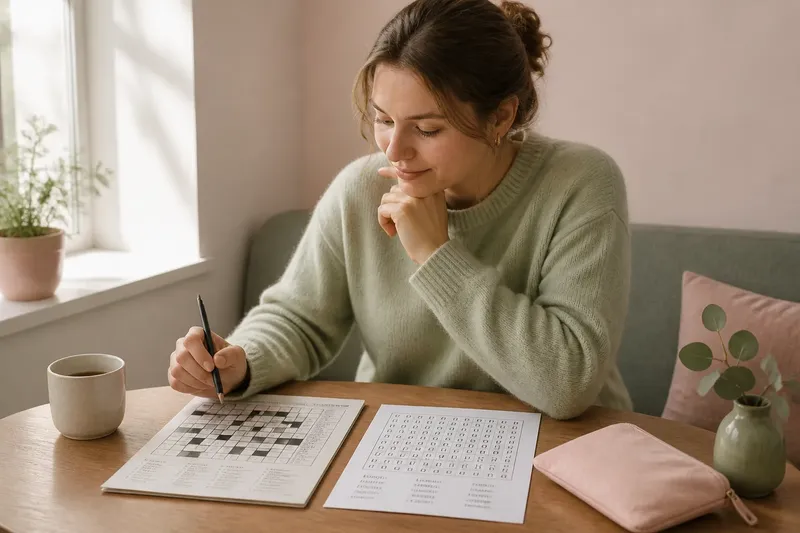
The common mistake is choosing a puzzle by its page size, then discovering that the task asks for a kind of attention you do not have. Crossword first or word search first is a better question to ask before a short break or a longer session: one asks you to retrieve and connect information, while the other asks you to scan and recognize patterns. Picking the better fit can make a spare moment feel satisfying instead of stalled.
Why does the puzzle feel harder than the time allows?
A crossword can look manageable while quietly demanding sustained thought. Each clue is a small retrieval problem, and answers often depend on crossings, wordplay, or a particular meaning of a familiar word. If your attention keeps breaking, you may reread clues without making progress.
A word search has a different friction point. You need to inspect a field of letters, hold a target word in mind, and check possible paths. That repeated visual scanning can feel tiring even when the vocabulary is easy.
Try matching the format to the interruption level. A quiet stretch with room to think favors a crossword; a brief pause with likely distractions may suit a word search, especially one with a small, clear grid. Neither format is automatically easier: the mismatch between task and moment is often the real problem.
When should you choose a crossword first?
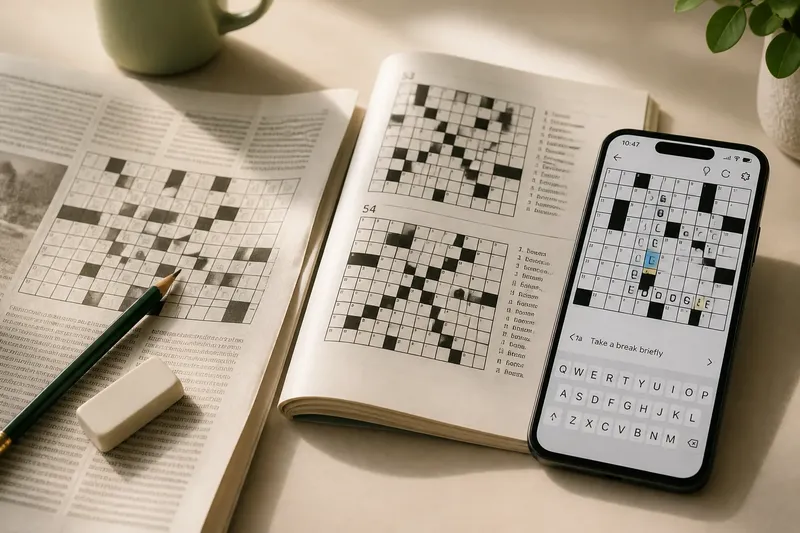
Choose a crossword when you want to work with language rather than simply spot it. Clues may call for definitions, associations, wordplay, or knowledge of a topic. Crossings give you a way to test a guess: letters from answers you trust can narrow the possibilities in uncertain entries.
This makes crosswords rewarding when you can keep several clues in mind and return to an unfinished answer. They also suit a longer session if you enjoy the gradual shift from scattered guesses to a connected grid. A themed puzzle can add another layer, since related answers may reveal a pattern that helps with later clues.
If you are stuck, do not keep pressing on one clue. Fill in answers you know, then revisit the difficult entry with its crossing letters in place. If a clue still has several plausible readings, leave it open; forcing a guess too early can make neighboring answers harder to judge.
When is a word search the better first choice?
Choose a word search when you want a direct visual task with a clear target list. You know what you are looking for, and the challenge is locating each word among distractor letters. This can feel more accessible when you do not want to decode clues or summon specific knowledge.
It can work well for a short break because you can pause after finding a word and resume without reconstructing a chain of reasoning. A compact puzzle with a readable type size is often easier to dip into than a crowded page. On the other hand, a large grid or a long word list can turn the activity into prolonged scanning, so the format is not always the lighter option.
To reduce visual drift, search in a consistent way. Pick a direction—such as horizontal rows first—and check the listed words against the grid rather than wandering across it. If your eyes keep losing the line, pause briefly or use a finger or pencil to track the row.
What should you try when the format is not clicking?
When a crossword stalls, identify whether the problem is knowledge, clue wording, or a mistaken crossing. Re-read the clue for its grammatical signal: a plural answer usually needs a plural form, while a question mark may hint at wordplay. Then erase or reconsider any crossing answer that rests on a guess rather than a confident clue.
When a word search stalls, check whether you are scanning in too many directions at once. Search for a distinctive letter sequence or an unusual letter in a target word, then trace outward from possible matches. If the puzzle allows words to run backward or diagonally, confirm those directions on the instructions before assuming a word is absent.
Say you have a few quiet minutes before an appointment and keep losing your place in a crossword. You set it aside, take a small word search with a short list, and scan one row at a time. The expected observable result is a task you can pause cleanly after spotting a word, rather than a set of clues you must keep mentally open.
Not worth the effort: timing yourself or turning a relaxing puzzle into a contest with your own solving speed. A simple change of format or a brief pause usually gives you more useful information about what fits than a stopwatch does.
Which puzzle fits your break, and what else might you wonder?
Is a crossword or word search better for a short break?
For an interrupted pause, a word search is often easier to leave and resume because its targets are explicit. A crossword can still fit if you enjoy returning to a few open clues rather than finishing the grid in one sitting.
Which one asks for more concentration?
Crosswords tend to ask for more verbal retrieval and clue interpretation, while word searches ask for sustained visual scanning. The harder format depends on whether language recall or visual tracking feels more demanding to you that day.
Can you switch puzzles during one session?
Yes. Switching can help when one kind of attention feels worn out: move from interpreting clues to scanning for words, or the reverse. Keep the unfinished puzzle nearby so you can return without treating the switch as failure.
What should beginners try first?
Start with the format whose basic task sounds inviting: solving short clues or finding visible words. A beginner crossword with clear, familiar clues or a word search with a compact list can make the rules easy to grasp without requiring a long commitment.
How can you make the choice before opening the puzzle?
Use a quick check of your present attention rather than a fixed rule about which puzzle is better:
- Have a clue-solving mood? Pick a crossword if recalling words and testing crossings sounds appealing.
- Expect interruptions? Favor a word search when you want an obvious place to resume.
- Feeling visually tired? Avoid a dense word-search grid and choose a crossword with uncluttered print, or take a break from both.
- Want a longer, connected challenge? Try a crossword whose entries build on one another.
- Want a clear target and a simple stopping point? Choose a word search and mark each located word as you go.
Crossword first or word search first comes down to the attention you can comfortably give, not a ranking of puzzle types. If you want language retrieval and connected reasoning, open the crossword; if you want visual searching with explicit targets, start with the word search. Let the format serve the break you actually have, and change course when it stops feeling like the right task.