The Neat-Answer Trap in Logic Grids
The neat-answer trap in logic grids starts with one persuasive match. Learn to test every clue against the whole grid before committing to a solution.
The most common logic-grid mistake is writing a tidy-looking match in ink before checking what it forces elsewhere. The neat-answer trap in logic grids can turn one plausible pairing into a chain of confident, incorrect marks—and make a solvable puzzle feel inconsistent.
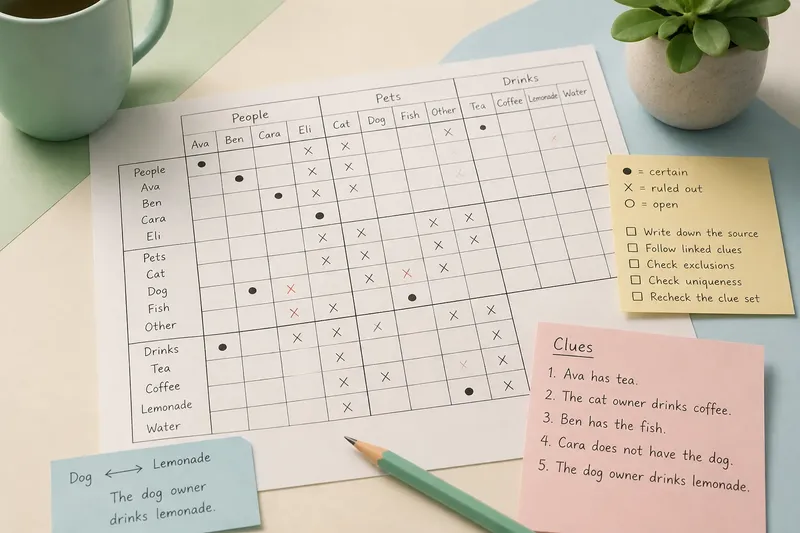
Imagine a puzzle about four friends, their pets, and their drinks. Each person has one pet and one drink, and no category contains duplicates. The clues are: Ava has tea; the person with the cat drinks coffee; Ben has the fish; Cara does not have the dog; and the dog owner drinks lemonade. There are four people, four pets, and four drinks. The fourth name, Eli, and the fourth drink, water, are part of the grid, though neither appears in a clue.
At first, one pairing seems to complete the story: Cara has the dog and drinks lemonade. It gives two linked matches and leaves a satisfying arrangement to work with. But the clues never say Cara has the dog. The pair is a guess dressed up as a conclusion.
Why does the neat answer look convincing?
Logic grids reward visible progress. A linked pair such as “dog—lemonade” feels more substantial than a row of exclusions, and it is tempting to attach that pair to a person to make the grid look fuller. The eye tends to prefer a complete little pattern over several open possibilities.
That preference can hide the difference between a clue and an assumption. “The dog owner drinks lemonade” establishes a relationship between two categories. It does not identify the owner. “Cara does not have the dog” rules out one person, but it does not make her the owner by default.
The invented puzzle makes the trap easy to see. Ava’s tea rules out Ava as the lemonade drinker. Cara’s dog exclusion rules out Cara as the dog owner, and therefore rules her out as the lemonade drinker too. Ben’s fish rules out Ben as the dog owner. That leaves Eli as the dog owner, so Eli drinks lemonade. The neat Cara pairing conflicts with clues already in the grid.
This is the cost of committing early: later clues seem to contradict one another, even though the contradiction came from the solver’s unsupported mark. The useful response is not to force the remaining cells to fit. It is to trace the assumption back to its source.
How can you test a guess against the whole grid?
Start by separating established facts from possibilities. Use the grid’s notation consistently: a filled mark means the pairing is certain, a cross means it is ruled out, and an empty cell means it remains open. If your puzzle uses different symbols, follow that convention. Avoid treating a pencilled possibility as a fact just because it has been there for several minutes.
Next, test a proposed match in both directions. If you suppose Cara has the dog, the dog-and-lemonade clue makes her the lemonade drinker. Now compare that result with every clue involving Cara, lemonade, dogs, and the people already linked to those categories. Cara’s stated exclusion immediately rejects the proposal.
A useful check is to ask what a match forces, not merely what it appears to fit. A candidate is sound only if its consequences can coexist with all the clues. One compatible clue is not enough; a candidate that violates another clue is out, no matter how neatly it fills a row.
- Write down the source. Mark a pairing as certain only when a clue or a chain of deductions supports it.
- Follow linked clues. A person’s pet may determine a drink, or a drink may rule out a pet. Carry each consequence through the grid.
- Check exclusions. Make sure a proposed match does not contradict a “not,” “neither,” or “does not” clue.
- Check uniqueness. If every person must have one drink, a confirmed drink for one person rules it out for the others.
- Recheck the clue set. Before declaring a contradiction, ask whether it came from the puzzle or from an earlier guess.
These checks are not a separate solving system. They are a way to keep the grid honest while deductions develop.
What does a careful solve look like?
In the invented grid, begin with the direct clues. Ava—tea, Ben—fish, and the pair dog—lemonade can be marked as facts. Cara—dog is crossed out. Because the dog owner has lemonade, anyone ruled out as the lemonade drinker is also ruled out as the dog owner, and vice versa.
Ava cannot own the dog because she drinks tea, not lemonade. Ben cannot own the dog because he has the fish. Cara cannot own the dog by the direct exclusion. Eli is the only remaining person, so Eli owns the dog and drinks lemonade. This deduction is supported by the complete set of clues and the one-to-one rules of the grid, not by a preference for a tidy arrangement.
Now fill only what follows. Ava, Ben, and Eli have their drinks or pet determined, but Cara’s pet and drink are not yet fully identified. The remaining pets are the cat and one other pet; the remaining drinks are coffee and water. Since the cat owner drinks coffee, the cat must pair with the coffee drinker. The clues so far do not say whether that person is Ava or Cara, and Ben’s fish and Eli’s dog exclude them as cat owners.
At this point, pause rather than choosing whichever completion looks more balanced. The clues provided in this invented puzzle do not identify whether Ava or Cara has the cat, nor which of them drinks coffee. There are multiple completions consistent with every clue. That is not a failure to solve; it shows that the puzzle as written lacks enough information for a unique full grid.
This distinction matters. A solver should not invent a missing clue to make the final rows look complete. If a published puzzle is expected to have one solution, check that no clue was skipped or misread, and verify that the grid has been copied correctly. If the ambiguity remains, the puzzle may simply permit more than one answer.
What should you do when a deduction stalls?
Return to the open cells and ask which clue connects the most categories. In this puzzle, the dog-and-lemonade link is productive because direct clues eliminate three people from owning the dog. In another grid, a clue connecting a person, a place, and a time may be more useful than one that rules out a single pairing.
It also helps to distinguish a temporary assumption from a deduction. If you choose to explore a possibility, mark it clearly as provisional and record its consequences in a separate note or with a distinct pencil mark. If those consequences contradict a clue, discard the assumption and undo only the marks that depended on it. Do not erase established facts alongside the guess.
When a contradiction appears, trace backward from the conflicting cells. Find the first mark that was not directly stated or logically forced. That is often where a plausible guess slipped into the role of a fact. This audit is more useful than repeatedly rereading the entire puzzle without a specific question in mind.
Which questions help prevent premature answers?
Can one clue prove a complete arrangement?
Usually not: a clue may establish one relationship while leaving several category matches unresolved. Treat only its exact statement and necessary consequences as certain.
Should I fill every empty cell as I go?
No. Empty cells are useful when the clues have not ruled them in or out. Leave them open rather than selecting a candidate to make a row look finished.
What if my grid seems to contradict a clue?
Trace the marks that led to the conflict and identify which are deductions and which are assumptions. Recheck the assumptions first, then confirm that you copied and interpreted the clue accurately.
What if two answers still fit?
Compare both arrangements with every clue and the grid’s one-to-one rules. If neither violates anything, the available information may not determine a unique solution.
What is not worth the effort?
Do not keep polishing the grid’s appearance by filling cells that lack support. Color-coding, rewriting the entire grid, or adding elaborate notation can also become busywork if the actual problem is one untested assumption. A clear pencil mark and a short note about why it is certain are often enough.
The neat-answer trap in logic grids is avoided by treating the whole clue set as a single test, not a collection of prompts for attractive pairings. In the invented puzzle, checking every clue exposed the tempting Cara match, established Eli’s dog and lemonade, and also revealed that the remaining clues did not settle the full grid. That is a useful result: a sound partial solution is better than a complete arrangement built on a guess.
Before your next confident mark, ask one last question: what else must become true if this pairing is right? If every consequence survives the clues, keep it. If one fails, the grid has done its job by showing you where to look again.