A Puzzle Table for a Rainy Afternoon
Plan a puzzle table for a rainy afternoon with varied solving times, room for discussion, and answer cards kept aside until someone asks.
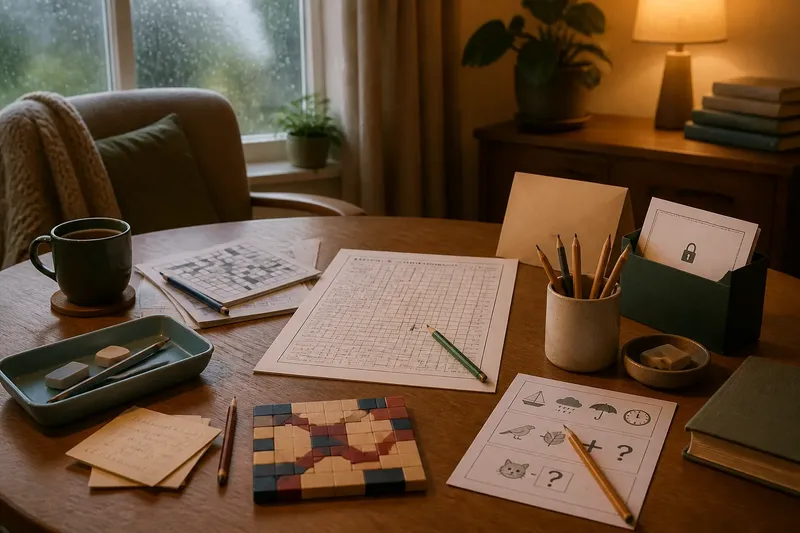
The common mistake with a puzzle table for a rainy afternoon is putting out a stack of equally demanding puzzles and expecting everyone to take turns the same way. Some guests finish quickly, others want to linger, and a person who needs quiet can feel pushed out by a group that talks through every possibility. The fix is to plan for different rhythms, not to make everyone solve alike.
Choose a few puzzles with different levels of commitment, arrange the table so people can work alone or together, and decide where solutions will stay until requested. Then let guests choose their own pace. A good session feels welcoming even when one person is puzzling aloud and another is still reading the first clue.
Who is coming, and how do they like to solve?
Start with the people rather than the puzzle pile. Think about whether your guests enjoy wordplay, visual patterns, deduction, or hands-on pieces. You do not need to predict every preference; just offer enough variety that nobody has to join a format they dislike.
If the group includes children and adults, favor puzzles with a visible starting point and room for several kinds of contribution. A rebus can invite guesses, while a small logic puzzle can give a more methodical solver a clear path. Keep a more involved puzzle nearby for anyone who wants sustained concentration.
For a group that already likes solving together, put out one shared challenge and a couple of independent options. This gives talkative collaborators something to gather around without making discussion the price of joining in. If your guests usually prefer quiet, make individual sheets easy to take to another seat.
Say you are hosting a mix of a fast crossword solver, a guest who enjoys visual riddles, and someone new to puzzles. You could place a short word puzzle and a picture-based riddle within easy reach, then keep a longer deduction puzzle at the center for anyone who wants to team up. The expected result is a table where each person can start at a comfortable level and move toward shared solving if they choose.
How much time should each puzzle ask for?
Mix commitment, not just subject matter. A quick puzzle offers an easy entry and a satisfying pause; a longer one gives guests a reason to return after tea or conversation. Put them side by side rather than making the shortest puzzle seem like a warm-up everyone must complete.
Use these broad choices to match the session:
- Drop-in gathering: Choose self-contained riddles, small word searches, or a few short pattern puzzles. Guests can start and stop without asking the group to preserve a complicated state.
- Unhurried afternoon: Add a medium-length crossword, a compact logic grid, or a puzzle with several linked clues. These suit people who want to settle in but may still take a break.
- Dedicated solving group: Offer one layered challenge that can hold attention across the session, alongside a shorter alternative for anyone who wants a change of pace.
- Mixed ages or experience: Pair an approachable visual puzzle with a more demanding word or deduction puzzle. Keep both open to group discussion, but let people decide whether to collaborate.
Do not judge a puzzle’s fit by its page count alone. A compact clue can take time if it depends on a subtle convention, while a larger puzzle may be easy to enter because its instructions and first move are clear. Read the directions before guests arrive and note any vocabulary or rules that may need a brief explanation.
Where can people think aloud without taking over?
Set the main puzzle where conversation can happen, but preserve a quieter edge of the table or a nearby chair for solo work. Keep pencils, erasers, scrap paper, and any pieces in a tray or shallow dish so a solver can move without scattering someone else’s notes. If the table is small, put spare puzzles on a side surface and bring them over when needed.
Make collaboration an invitation, not a default. A simple prompt such as “Would you like a hint or a quiet minute?” gives the solver control. If someone says a possibility aloud, let the group respond with questions rather than immediately announcing whether it is right. This keeps the conversation useful without turning every thought into a vote.
For a shared puzzle, designate a visible place for tentative ideas: a scrap sheet beside the board or a corner of the page. Mark guesses as possibilities rather than answers. That small distinction helps prevent a confident suggestion from being mistaken for a settled solution, especially when several people are contributing.
It is not worth the effort to enforce a strict turn-taking system for a casual gathering. A queue can make a relaxed puzzle feel like a meeting. Instead, give guests room to join, watch, pause, or switch puzzles; step in only if someone is being crowded out or the shared page is becoming hard to follow.
How do you keep answers available but out of sight?
Separate solutions from the puzzles before anyone sits down. Fold answer sheets inward, place them in an envelope, or keep a solution page in a closed folder on a sideboard. Do not put answers on the reverse of a sheet that someone might turn over while writing.
Tell guests where answers are and make it clear that asking is fine. A solver might want a nudge rather than the complete solution, so offer a graduated choice: a hint, a check on one answer, or the full explanation. If the puzzle comes with a printed key, avoid reading it aloud to the whole group unless everyone wants that.
For puzzles with multiple stages, keep any later-stage clue separate too. A visible answer to one part can spoil the pleasure of discovering the next. If a solution is requested, share it privately or cover the relevant section while explaining, then let the solver decide whether to continue.
What should you prepare before guests arrive?
A short setup makes the table feel ready without making the afternoon feel managed. Check that each puzzle has its instructions, that writing tools suit the paper, and that loose pieces cannot be confused between games. Keep food and drinks far enough from the pages to avoid accidental spills, and leave a clear patch for notes.
- Choose puzzles with different solving times and styles.
- Read each set of directions and identify a simple starting point.
- Put pencils, erasers, and scrap paper where guests can reach them.
- Set aside a quiet spot for people who prefer to solve alone.
- Store solutions in a closed envelope or folder.
- Keep spare puzzles available without piling them over the active ones.
When a puzzle depends on a particular printed rule, answer key, or publisher’s instructions, follow that material rather than improvising a rule for the group.
What questions come up while choosing the puzzles?
How many puzzles should I put out at once?
Offer a small selection that shows different styles and levels of commitment, then keep the rest in reserve. Too many open choices can clutter the table and make it harder for guests to see where to begin.
Should everyone solve the same puzzle?
Only if the group enjoys shared discussion. A central puzzle can anchor the gathering, but individual options let guests participate without matching the group’s pace or preferred style.
How can I help a new solver without giving away the answer?
Ask what they have tried and whether they want a hint, a rule clarified, or simply time to think. A question that points attention toward a relevant clue preserves more of the solving than announcing the next move.
What if one person finishes before everyone else?
Keep a short optional puzzle nearby or invite them to observe without commenting on another person’s page. That gives the early finisher something to do while protecting the other solver’s chance to work independently.
How can the table stay relaxed as the afternoon changes?
Let the arrangement shift as guests arrive, leave, or change their minds. Move a shared puzzle aside if conversation takes over, bring out another option when someone asks, and leave unfinished work undisturbed when its solver steps away. The point is not to complete every page; it is to make starting, pausing, and asking for help equally comfortable.
A well-planned puzzle table for a rainy afternoon has clear choices, a place for both lively discussion and quiet thought, and solutions that wait until they are wanted. Prepare those basics, then resist the urge to direct every move. Your guests can make the session their own.